Pages

Showing posts with label price. Show all posts

Sunday, 14 August 2016

#137 Ayutthaya, Thailand

Ayutthaya is an old city full of old ruins, a 2 hour train from Bangkok. Think of it like a cheap and convenient version of the temples at Siem Reap in Cambodia, and a nice day trip from the city. It is also a world heritage site.

While accessible via a private tour bus run by many hotels and hostels, I arranged the trip by myself by getting a train to Ayutthaya station, then a very short ferry ride across a river, then a tuk tuk around the ruins. Overall the whole thing cost about €20!

Train, Boat and TukTuk: Transport


The trains run quite frequently, I couldn't find a timetable online so I just turned up at Bangkok Central Hualamphong station (accessible by MRT) and asked for a third class ticket to Ayutthaya, which cost 20 baht (about 50c!). The train wasn't leaving for about another hour but I decided to go outside and check where it was leaving from, and it was actually already there. Third class looked dodgy with unscrupulous looking men, but the attendant pointed me towards the 2nd class carriages. A sweet Thai girl then confirmed that despite the ticket I could sit anywhere and encouraged me to sit beside her in the leather seats in 2nd class, which also had fans and open windows.

Since I was on a day trip I only had a small bag, but there were many backpackers with large bags who had trouble fitting on the train. The train also filled up well before departure time and people had to stand. So if possible, please be early for your train and check if it has already arrived. You do not want to stand, especially with backpacks and also local venders walking up and down trying to squish past you carrying who knows what!

The return journey home cost 29baht (75c) because it was a slightly faster train. The seats weren't as comfortable, hard benches, but it was fine, almost everyone managed to get a seat, and it was mostly full of backpackers.

On arrival, you just need to walk across the street and keep walking until you find the river, it's very close, and there are many other backpackers who you can ask for help or try find it together! The ferry cost 5baht each way (about 25c or so total) and it leaves every few minutes and takes literally 2mins.

Upon exiting the ferry there is bicycle rental which I did not partake in due to the heat, but is definitely a fun and cheap way to see the area if you have good fitness and a change of clothes afterwards (you will be drenched in sweat). It is also possible to rent like a motorcycle, but there was no way I was trying that! I walked past this and was met by some tuk tuk drivers who tried to charge me like 1,000baht. I had read the average price was around 400baht, and eventually I got them to 500baht (€12) for 2 hours and gave up because I was alone and hate haggling. As for the length of time, I felt rushed in 2 hours, but then the temples all start to look alike after awhile and it's very hot so I don't think I would have been up to much longer either.

TukTuk Trauma


My only problem was this; the tuktuk driver who I was speaking to first took me to another place and switched drivers to some young guy. This guy apparently had absolutely no English and no idea where any of the temples where. He got lost trying to find one of the biggest ones and we circled around for about 10 mins, then he stopped and asked for directions, and then he eventually dropped me off at the wrong one. I obviously didn't even try to tell him and get to the right place as it would have wasted more time. As I said the temples are quite similar so it wasn't a huge deal, but it was still frustrating.

Entry to the temples cost about 50baht each (€1.20) but there are some that you could easily just take photos outside instead of paying to go in, even though it's a small fee it starts to add up after awhile!


Overall, it was a fun day out and wasn't too difficult to organise on the day without any prior booking. It was very cheap and a bit of an adventure getting outside the city, and I was happy to see some ruins as I couldn't make it to Siem Reap this trip!

Friday, 17 June 2016

#132 Preparing to Climb Mt Fuji 2016

EDIT: To read about my climbing experience and for details on the Fujinomiya trail please check out my most current post here.


I currently live in Shizuoka Prefecture, which is the “Home of Mt Fuji” (although part of Fuji also lives in Yamanashi Prefecture too!). Since it’s nearby, I decided I had no excuse not to climb Fuji before I leave this summer.


Getting There

Firstly, there are English language tours for around 20,000yen departing regularly from Tokyo, so if you are a tourist I would probably recommend booking one of those for a totally hassle free climb. However, it’s not difficult to do it yourself, as there are daily buses to/from Tokyo all through the climbing season (check out Willer for bus information)
You can also reach the mountain by getting a Shinkansen to Shin-Fuji station, and from there a 2 hour bus.


When to climb

Fuji is only open from around mid July to early September. This short climbing period means it’s always busy. Weekends and basically most of August (from around 10th to 20th maybe) are particularly crowded, and it’s possible to wait in line to get to the summit, especially at sunrise when lines can become quite long. I’ll be climbing on a Sunday-Monday because of work restrictions, but ideally I’d have liked to climb mid-week.


Night Hiking or Sleeping Over?

l  Many people choose to hike through the night and reach the summit at sunrise. This is officially not recommended as it can cause more accidents since people are tired and sleepy, and also climbing quickly increases the likelihood of altitude sickness. Despite this, thousands climb at night every year and experience absolutely no problems, and it is a cheaper, easier and faster alternative to sleeping over.

l  I will be sleeping over, mostly because I am worried about altitude sickness and the detrimental effects on my poor fitness level. You need to reserve your space in the hut well in advance of your climb, especially at weekends and the middle of August. Unfortunately many huts still only take phone reservations, and only some speak English. This website lists all the huts on the Fujinomiya route, including information like prices and availability, as usual it’s just in Japanese but is very easy to Google translate. You can also find more basic information on all the routes on the JNTO website.

My mountain hut in 2016
So, you just reserve your place in good faith and pay cash when you arrive. The prices are around 5,500yen for sleeping and 7,500 including breakfast and dinner. Dinner is usually something basic and filling like curry rice, but I have no idea what to expect from breakfast (EDIT; It was bread and not worth the 1,000yen). Dinner is served until around 6pm, since many climbers sleep early and wake up around midnight and in the early hours to climb again in order to reach the summit for sunrise at around 5am.

The huts are in no way glamorous – you will be in a big room in a sleeping bag with 250 people on either side of you. There doesn’t appear to be much personal space and I’m a little concerned about the smell after everyone hiking all day – but I’m sure it’s all an experience! 


I booked the 8th station (Ikeda Kan) on the Fujinomiya route online via their website – it was in Japanese but I translated it and their confirmation email was in English, presumably because they saw my foreign name. This also leads me to believe that even huts that officially have no English are probably so used to foreigners that they can communicate at least a little.


Fitness Level

Everyone hears stories about children and little old ladies climbing Fuji every year. However, there’s a reason why the Japanese live so long – they are very active into old age, and these little old ladies are probably out doing calisthenics at 6am in the local park every day so it would be foolish to underestimate their fitness level and compare them to the average old ladies in your country.
Now, from what I hear Fuji is not a difficult climb – you don’t need specialist climbing equipment or a Sherpa to help guide you. However, it’s still a mountain and should be treated as such. Taking your time, sleeping over and carrying the appropriate clothing and supplies will make it much easier.


Route

There are five routes total, but to be realistic and save time I’ll only tell you about the two popular routes.
l  Yo shi da – This is the most popular route, probably due to ease of access from Tokyo. It is also the most crowded but has a large amount of facilities such as toilets, huts and stores. It starts from quite low down but the incline is reasonably gentle (for a mountain anyway).
l  Fuji no miya – This is the route I will be climbing (just because it’s nearest my house), and is accessed by Shin-Fuji station. It is the shortest climb to the summit, but it is steeper than Yoshida. My friends said that it took them about 8 hours climbing all night, taking long breaks too. The estimate is about 4-7 hours to climb up and half that to descend.


Equipment and Gear

You need to be prepared for cold weather; although it may be 30 degrees Celsius outside, by the time the bus drops you to the 5th station it's quite high up and already you'll feel a slight chill. If climbing at night be prepared for it to be especially cold. The weather is also said to be very changeable so raingear and a change of clothes is also advisable.
l  Renting: I found Kobe Outdoor (mtfujirental .com) was very useful – their website is modern, fully in English and they deliver to hotels/AirBnBs from 3 days before your climbing date so you have time to change sizes etc, and you can return them within 24 hours of climbing at a convenience store. I have ordered hiking boots from them, so I will update and let you know if they are as good as they seem! (EDIT; They are! Even delivered a day earlier. Great service).
l  Walking Stick – This costs about 1,000 yen and is available at all the stations. You can get it stamped for 200yen at each station on the way up and is a popular souvenir (although awkward to fit in a suitcase coming home perhaps…)
Here's a few other things you should definitely take with you;
l  Hiking boots + thick socks
l  Oxygen cans (available at the base stations but very expensive so buy in advance)
l  Sunscreen
l  Sunglasses + hat
l  Rain coat and pants
l  Thick coat
l  Thermal top + leggings
l  Hat + gloves
l  Headlamp (night hiking)
l  Eye mask + Ear plugs (if sleeping over)
l  As much water as you can carry - prices get to 500yen for 500ml from the 7th station...


Last summer I met a guy with incredible sunburn – turns out he was recently climbing Fuji at night and was so busy preparing his gloves and coat that he forgot that he would be climbing down the mountain in daytime in the height of Japanese summer….needless to say I learned from his mistake and sunscreen and a hat are top of my list!


More Useful Links

The famous sunrise - actually seen from the 8th station

Thursday, 2 June 2016

#130 No More Sleeper Trains From KL-SG/SG-KL

As of 19th May 2016, the timetables have changed and getting the train from Kuala Lumpur to Singapore (or vice-versa) is no longer a viable option.

Unlucky for me, the change was made one day after I finally booked my flights, one arriving into KL and one leaving from SG, which means I need to find another way to get from KL-SG.

You can find more info about the updated timetable here on Seat61: http://www.seat61.com/Malaysia.htm#Train_times
There are no more overnight sleeping-cars on the Malaysian north-south route. You now need to change at Gemas when travelling from Johor Bahru [Singapore] to KL.”

The new schedule means the train now leaves Kuala Lumpur at 1.22am, and you must get off and switch trains at somewhere called Gemas. You arrive into Gemas at 3.40am but you won’t leave until 4.10am. You’ll arrive into Johur Bahru [Singapore] at 8.10am.
While not impossible to do, the very late departure time and changes in the middle of the night now makes this route a no-go for most people, including me. If you’re still interested, the total trip costs around 52rm (11eur).

The Bus
Since you couldn’t book the sleeper train until one month before departure, I had previously decided to also look up alternative options should I be unable to book online in advance, or the train be fully booked. I could always get a flight, but that would waste time and be more expensive. Thankfully, there’s a bus.

The bus from KL to SG takes around 5 hours (estimates range from 4.5-5.5hrs depending on traffic) and costs range from 30-45sgd (20-29eur), but the average is 37sgd (24eur). Just like with the train, it is more expensive to go from SG to KL, so keep that in mind. It appears you can book the bus much further in advance, at least 3 months, and I have read that they work with foreign credit cards.

Most of the buses appear to be luxurious. There are large, individual, reclining seats with lots of legroom, built-in massage functions, entertainment system and charging point. It is similar to first or business class on an airplane, and totally different from your average bus in most countries! They also provide water, hot drinks and a meal during the journey, and make rest stops for the bathroom along the way.


The first buses leave KL at 7am (arriving around midday) and cost 37sgd (24eur), and the last bus leaves 11.30pm. Since the journey is only around 5 hours, it would mean arriving into SG around 5am, which unless you’re heading straight to the airport I obviously wouldn’t recommend.

The buses from KL usually leave at Berjaya Times Square (a central hub of the city and near many hostels and hotels) and arrive into SG at Golden Mile Complex, a mall which is a 5min walk from Nicholls Highway MRT station so convenient for transfers.

The bus ticketing sites I found are busonlineticket.com  and easybook.com. I have yet to use these sites so I cannot verify their trustworthiness, but easybook seems to be…well…easy to use, but busonlineticket is quite similar, and the times/prices are all the same. You can also book direct from the company, so it might be a better idea to use the aforementioned sites to find the bus you want, and then book it directly from the company.

I have read many reviews online about Transtar Soliataire bus service, and that is also the one that leaves first at 7am, so I will likely get that one. However, I have also read some reviews that said the bus was an hour late. This would be very unfortunate, as I had first planned to take the train and arrive in SG at 9am, and now it will be around 12pm earliest. I have seen mentions of Aeroline, but when I look at the bus options on the ticketing sites it is not one of them, so perhaps it only works SG-KL direction.

While at first I was obviously annoyed my best laid plans have come apart, and that I’ll now have to spend more money on an extra night in a hostel and a more expensive bus ticket, and also that I will be arriving into SG a few hours later than expected, it’s not all bad.
The bus looks like a fun experience, and by Western standards the ticket is very cheap. It’s also easier than trying to figure out the Johur Bahru-Woodlands shuttle, and the new collection and drop-off points are very close to both my hostels in KL and SG.


Basically, I’m just glad I noticed the timetable change now and can figure out the bus and book another night at my hostel. I’m just worried for people who were expecting to get on the sleeper train soon and have not been made aware of the changes.

UPDATE: I took the Transtar bus from KL to SG last week. It was a good bus and good service, the only downside was it took the full 7 hours - we left 7am and arrived 2pm.

Thursday, 19 May 2016

#127 Mutianyu Great Wall Tour

To get to Mutianyu Great Wall I took a tour with my hostel - it was actually a communal tour bus shared by quite a few hostels in Beijing. It leaves everyday and was 280rmb, plus 100 for the cablecar that you pay at the Wall. There's just no way you're not getting the cablecar so we'll call it 380rmb (50eur). 

It includes breakfast at your hostel (we had choice between like European cheese-yogurt-cereal or American bacon-eggs-toast), a nice, clean, air conditioned bus, an English speaking guide (who explains a little and then leaves you to scale the wall yourself at your own pace), 3hours time on the wall (it was plenty, enough time to get all the photos you ever need), lunch at the bottom of the wall and then return bus home.

The nice thing about the lunch is that if you're running late you won't be left behind - you'll just miss out on the food. The bus took just over 1hr30mins from Beijing, and we left around 8am and returned at 4pm. There were no stops at any souvenir shops or anything.

While not expensive on the grand scale of things, it's definitely a rip-off in comparison if you were to do it yourself. Overall, while I wasn't delighted with the price, I was happy with the service and would recommend it if you want an easy, convenient, hassle-free trip. Plus, on the grand scale of things, 50euro is very cheap to pay to go to the Great Wall of China!

From the photos I've seen (on Instagram) it appears that Badaling is busier than Mutianyu, and also I'm not sure it offers the same views or amount of watch towers. It looks alot more flat and sturdy - which does go with the often heard criticism that it's "over restored" but would make it very accessible, although as I've said before Mutianyu isn't difficult.

The hostel I stayed at in Beijing was Dragon King. I initially had somewhere a little cheaper, but then I noticed it was a little far from the nearest subway station, so I moved to Dragon King. It was located right beside Zhangzhigonglu station which made it really convenient to travel around Beijing, and even come back during the day for a nap! The same tour seems to be organised with Happy Dragon, Downtown Backpackers, Red Lantern and some more, but you should check first.

Saturday, 14 May 2016

#126 Beijing Transport

Getting around Beijing is very easy, even with no Chinese and a terrible sense of direction.

Taxi

The one taxi I used had no English but I had prepared my destination in Chinese in advance. He copied it into his GPS, turned on the meter and soon I was there! I can't verify they are all so honest, but it was a good experience, compared to Manila when they always ripped me off or took me wrong place.

Subway

The subway is the main method of transportation around Beijing. It was completely in English, including transfers and announcing the next stop, and also the signs and transfer directions in stations. I found it very easy to navigate - but I would caution you to know which exit to take and what direction to go when you get there. Anyone who has experience with large underground stations will know one wrong exit and you're completely confused.

It is cheap, as most trips will cost only 3-4rmb (50c). As for accessibility some transfers between lines can be long, and a few have only stairs (including transferring from Yonghegong Lama temple to Dongzhimen for the airport express. Painful with a suitcase!)

A sign on the platform. The subway car has similar inside but it lights up for the stops.

I bought a subway transport smart card for 20rmb refundable deposit. My hostel advised against it because there weren't so many places to return but I decided it would be easier than queueing for tickets and working out fares so I got it anyway, and was able to easily return it at the airport express station at terminal 3 before I left China. You can buy it at any subway station, but can only return at some bigger, major stations. There are machines that you can use to buy tickets or top up your card but I thought it was easier to go to the desk.

You should note that all subway stations in Beijing have security checkpoints, and you have to put your bag through an x-ray machine before scanning your ticket. Apparently this can cause lines at bigger stations at rush hour but I didn't have any problem waiting.


The subway has many (unofficial) apps which work offline, the one I used was 'Explore Beijing' for android and it worked just fine, telling me the start and end times of train lines, how to get there and where to change. It also had an area for people to submit 'tips', some were useful for pointing out exits etc.

Bus

The bus has OK English, and is ridiculously cheap (I paid 1.5rmb [20c?] for about a one hour journey). At one point I got lost and couldn't find a subway, but I found a bus stop on the side of the road. It was basically all in Chinese, but thankfully my Japanese skills allowed me to work out the name of one of the central stations and I waited for that one.

However, once actually on the bus there is a list of stops in English and it also indicates ones that have subway transfers, so worst case scenario you could always just get on any bus and get off at the stop with a subway and find your way home from there. The bus also announces stops in English and it flashes up in English too. Also to note, you get on the bus at the front and get off in the middle, and swipe your card getting on and off.

Walking/Street Names

A subway station at 5.30am...very quiet
Many street names have both Chinese characters and the English written underneath.
Due to the Great Firewall Google Translate won't work, but you can download the offline Chinese package. The only problem is that it doesn't show you the reading/pronunciation - so you won't be able to even try say it, just show it to someone.

You can even get a boat from Beijing Zoo to Summer Palace!
The same with Google Maps - while alone and lost I was desperate enough to turn on my roaming when I suddenly remembered the firewall would block maps anyway.
So instead I used my offline Chinese app to ask a street cleaner where the subway station was (for some reason I decided a city worker might be more kind than anyone else), she couldn't explain in English but a man came along and he showed me to a bus stop. Later the woman walked by again and came over and checked I was OK (I think!) which was very kind of her. So don't be afraid to ask for help if you need it!

There are also some offline maps apps but I didn't use any.


Monday, 9 May 2016

#125 Mutianyu Great Wall of China

The view from 23, the highest part at Mutianyu
The first thing you should know about Mutianyu is:

 it really is Great.

The second thing you should know about Mutianyu is that you absolutely need the cablecar. It's apparently over one hour walk from the bottom of the mountain to the wall. Unless you literally have all day, are in very good health and enjoy hiking up mountains - don't do it.
The wall itself is more than do-able even on a bad fitness level, but combined with the walk up the mountain it would be very tiring. The cable car is 80rmb one way or 100 return (13eur) - it's definitely not cheap but it's a necessity. You didn't come all the way to China and Beijing and Mutianyu Great Wall to blow it all and have a terrible time because you were too cheap at the crucial time.

The third thing you should know is that I haven't been to Badaling, so can't officially comment - but the Instagram pictures don't look quite as good, and the photos seem much busier too. I loved, loved, loved Mutiantyu. The views were great, the walk wasn't tough, and the crowds were nowhere to be seen.

Fitness

As for fitness level, anyone can do it. Literally, there's even wheelchair access (although you won't be able to get too far along before encountering steps). I am young but have a terrible fitness level, so even though I'm out of breath I have the drive and determination to keep going awhile longer. I made it to 23, which is the highest part (before you get to the old part of the wall - some people go along there, most give up) it wasn't easy but it was perfectly do-able with a few rest stops and water. There are also many turrets which provide lovely shade too!
At first I thought it would be too far/difficult to go that far, but then I had plenty of time so I decided to do it, so you should try it too! Great view and you'll feel you've accomplished something.

When to Go

When I went, a Thursday morning after a big Chinese holiday the previous weekend, the wall was pretty empty. I was a little worried about people bothering me trying to sell me things, but they were only about three that I saw and they didn't approach anyone. However, this also means you should plan accordingly and bring plenty of your own water and snacks. I overheard someone say water was 15rmb, when usually it's between 2 and 4rmb. Also I was told there were toilets in some of the turrets along the wall - I personally didn't notice any, so it's definitely best to go on the ground before you get the cablecar up.

What to Wear

For clothing, I think sneakers/runners, exercise clothes, a hat plus a backpack is best. I saw some people wearing jeans and pretty shoes and carrying handbags - while it's possible you just won't be getting very far or very fast. In May it's hot (26-31c), and although you're up high it's still very warm and all the walking will have you breaking a sweat. Pro tip: Bring a spare T-shirt to change into. No matter how much deodorant I put on I was still a little stinky on the bus home, and wished I had something else to change into.

Also note there is a ropeway/slideway, but this is not the cablecar I'm talking about. This is maybe a little cheaper but it takes you further down the wall, it's literally lower down on the wall than where the cablecar drops you so I'm guessing the view isn't as good and the hike to 23 would be much harder.

Getting There

Finally, as for access, you can get there via public transport, but I did something I would usually never do and I went as part of a tourr in a private bus (read more about this in my post here). This was arranged by a few hotels/hostels  around Beijing and cost 280rmb, plus 100rmb for the cablecar. 
It was much more expensive than going via public transport, but since I was alone and not so familiar with the language it was just easier to go this way. Also, 380rmb (50eur) for a trip to the Goddamn Great Wall of China isn't too bad!

These steps at 23 (the end of the new part of the wall) are as bad as it gets, I promise!


Sign for the cablecar. There is also a ropeway but it takes you further away.
The view from the cablecar, a little scary!


Tuesday, 15 March 2016

#117 Kakegawa Bird and Flower Park

This is a popular attraction in Kakegawa, a stop on the Shinkansen in Shizuoka Prefecture, about an hour and a half south of Tokyo. There is also a small castle here, but overall, if you're not already in the area, don't bother stopping especially for this.


The entrance fee for the park for adults is 1,080 yen. It is then 100yen per food serving to feed the birds, so that’s probably another 500 yen. It’s then 500yen to get a photo with a penguin, or 300yen for a small owl. There is a footbath with fish which costs 300yen, and also a one hour buffet lunch for 1000yen. They do have free bird shows about twice daily.


Overall, the park is quite small. You see pictures and assume it’s much larger, but in reality there are only about 5 bird enclosures. For the price, which probably ends up around 2,000 yen for most people, I think it’s too much.

There is not so much information in English, apart from the bird names. They have notices that you must pay 100yen for bird food, but they don’t bother to translate safety notices like ‘These birds like to bite’ which I find typical of Japanese thinking of “Make sure the foreigners pay and don’t break the rules, but if they want helpful information they should learn Japanese or get out of the country.” (Maybe it’s a little unfair, but I have seen enough notices, or lack-of notices, that this mentality just can’t be ignored.)


For the flower aspect, there’s not really that much going on. There’s an indoor greenhouse where the buffet is served and there are many flowers hanging from the ceiling, and a large lilly pond, but that’s basically it. Comparing with something like the Garden Park or Flower Park in nearby Hamamatsu it doesn’t level up at all.

Yes it’s fun to get a photo with a penguin, have a toucan sit on your shoulder and an emu chase you around a field, but that’s all the highlights. You could be in and out in an hour if you wanted. While I enjoyed myself, I couldn’t help but think the price was too high and the park too small. This is in comparison with a zoo, the average price of a zoo in Japan is probably about 500yen and it would be much bigger with a larger variety of animals, although admittedly you’re not likely to get a photo with a lion.


Overall I would give it 3 out of 5. It’s fun and interesting, but you would get better value visiting Hamamatsu Zoo and adjacent Flower Park. The zoo is 400yen, and the flower park varies by season but can be free, 500yen with a 500yen shopping voucher, or up to about 1,000 yen


If you’re only in Japan a short time I would skip it entirely, there are far better animal focused places to visit like Ueno Zoo in Tokyo and see Giant Panda’s for only 600yen, or take a trip to Nagano and see the famous snow monkeys relaxing in the hot springs.

Tuesday, 18 February 2014

#80 The Travel Show Podcast - Russia

This is a topical destination considering the Winter Olympics are now on, but it's also very contentious considering the issues with gay and LGBT rights. Personally, I am an advocate of gay rights, and I think the treatment in Russia is extreme. However, I am conflicted because Russia is a country I have wanted to visit for years now. Would the issues with LGBT rights affect your decision to visit Russia?

If you're going from Ireland, you can get return flights from Dublin to Moscow for about €250, and you will also need a visa. This takes about 20 days (so plan ahead!) and costs €60.


To listen back, go here;


Sunday, 21 October 2012

#20 Transport in Tokyo

To get anywhere in Tokyo, you have two options - the train or the subway. You could also factor in walking, bus and bike. But the first two are the ones you will use all the time. Car and taxi aren't options.

Here's some general info, as well as some hints and tips I've picked up:

Trains and Subways: 
Platform sign for the Yamanote Line around Tokyo.

There is one website you need, www.hyperdia.com
This website tells you how to get from one station to another, all you need to know are the names. It gives you different options, prices, and the timetables of the trains. Basically, it is a life saver and I use it all the time here.

Now, there are some things you should know. In Tokyo, everything is in English (including the platform signs and all the main trains have English signs and announcements for the next stop), so don't worry about that. Also, there is no such thing as a return ticket - everything is one way. This also makes it more expensive. And you should know the trains/subways aren't cheap. On a typical day going to and from any place will cost you about 1000yen.

The trains are cheaper, especially the JR ones (which are most of the ones around Tokyo). Tokyo Metro and the private subway lines always seem to be more expensive, so if you can, try get the trains for all or most of your journey.

The trains and subways run from around 5am - 12am. If you are caught without a train, there are hundreds of 24 hour cafes and restaurants on every corner you can just go into and sit down/sleep. I believe the Japanese are usually far too polite to come and wake you up.

The trains and subways aren't as crazy as you see on the internet, with a hundred people squished against the glass. Mostly. Weekdays from 7-9am is the only time you will see this, and I've been on these trains, and it is not a pleasant experience. Going home around 6-8pm is quite busy, but not near as bad as the mornings.
And don't worry about being groped - you probably won't be. I've been here two months and it's never happened to me or anyone I know, and talking to women who have lived here for years they say the same thing - it's not as common as the media would have you think.
Don't ever expect to get a seat. It is a rare and joyous occasion when this happens.

The Suica and Pasmo cards:
If you are going to be in Tokyo for more than a few days, I would recommend one of these. From what I understand these cards are both the same, but since I have the Suica card I'll give you more detail on that. Basically it is a type of credit card that's topped up with money, and then used to get the trains/subway. It is much easier and faster to just scan it as you go onto the platform than having to calculate fares and buy tickets each time. You can also use it to buy things at a lot of vending machines, as well as some supermarkets.

The Suica card cost me 2,000 yen, but this was with 1,500 yen on it to use, so really the price is only 500 yen, which is very cheap. It also gives you an option to put your name on it so it can be returned to you if lost (or they will give you a new card with the amount you had on the last card). I bought mine at a ticket machine in central Tokyo, although I am not sure if every station has these machines. Every station has machines where you can top up the card, and if there's a problem (such as you have no money left and the barriers won't let you leave. . .don't worry it happens often!) you can go to the help desk and they will sort it out. It's free to top up and use the card, so I'd see no reason for not having one (although my friend still doesn't, unbelievable!).

Car, bus, taxi. . . .
Driving in Tokyo is madness. Don't do it.
I've never gotten a taxi but they are supposed to be pretty expensive, and only to be used when you need to (such as if the train isn't running).
I've never gotten a bus either, but I always see them around Tokyo, so it definitely could be an option.
Bikes are pretty cheap here and you always see people cycling around the outskirts of Tokyo, not so much in the middle of the city. You can't put a bike on a train subway or bus though.


Walking
As with every city, you will walk until you can walk no more! Unless you're like some of the local girls and can walk comfortably in your six inch heels, comfortable shoes and blister plasters are a must. Crocs are very popular in Japan, especially during the summer, and now I know the reason why.

#17 Japanese Souvenirs

For a 2016 update please visit my more recent post here: Cheap Japanese Souvenirs

Although I live next to Tokyo, and work there most days, I haven't come across many souvenir shops! I mean you can buy lots of Japanese things that are cool and maybe you can't get in your country, but it's difficult to find shops that sell things like postcards and keychains, the usual Westerner souvenir! I found in many places the goods are often focused on Japanese tourists and not foreign travellers, so there are huge phone charm and biscuit selections but no fridge magnets or keychains! In addition, any souvenirs I have found aren't exactly cheap, and if I'm to bring things home for my family and friends at Christmas I need them to be a little more reasonable! So I'm on the hunt to find some of Tokyo's best souvenirs!

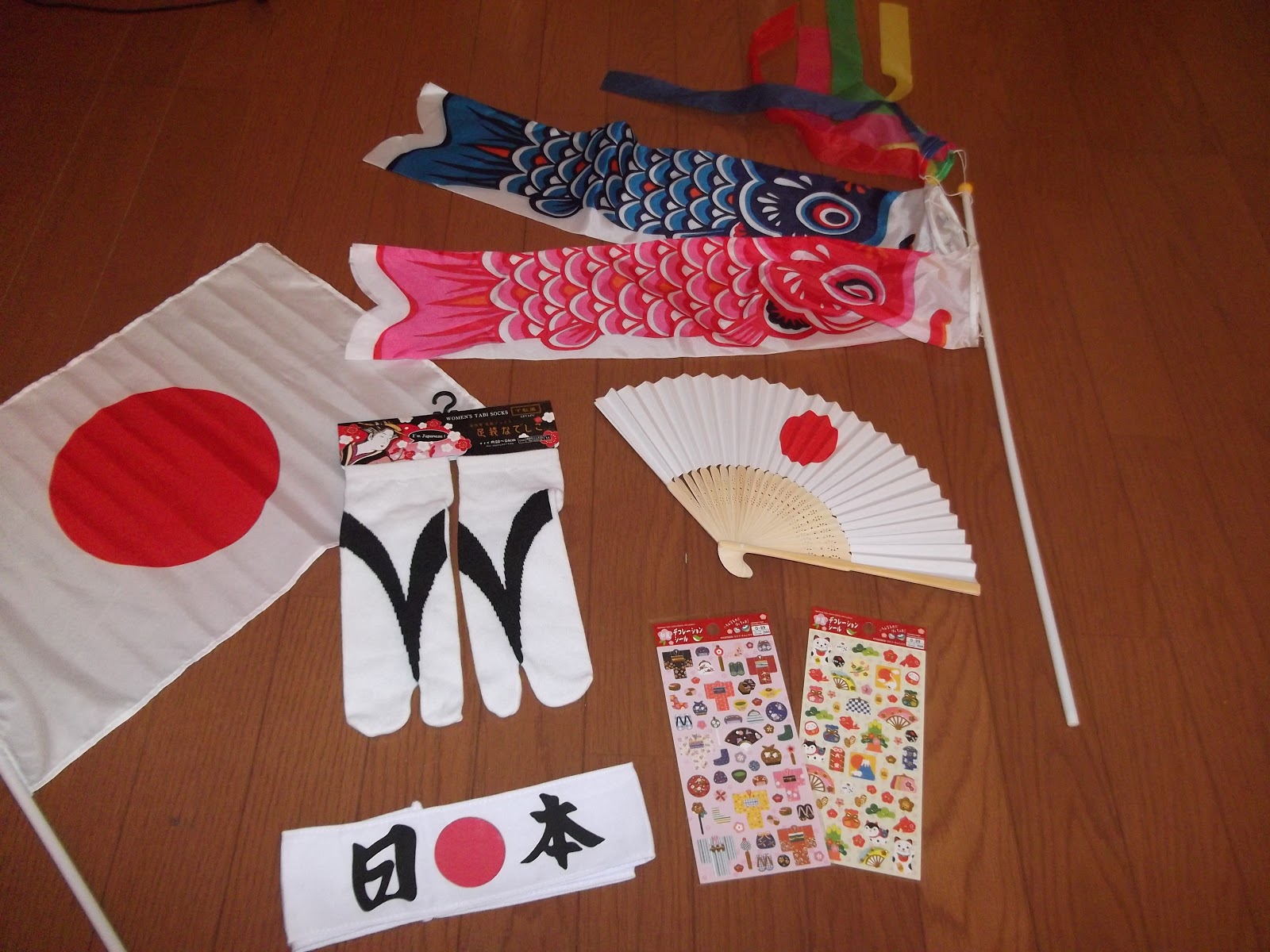
I went to Harajuku recently, and situated there is one of the biggest Daiso's (100yen store) in Tokyo. Although it seemed to have alot of what I've seen elsewhere, I did find some well priced souvenirs for 105-210 yen! Among these I bought two fridge magnets and a phone charm of a kokeshi doll, a japanese flag and fan, two packets of Japanese stickers, a Japanese headband, socks used for the traditional japanese sandals, and the carp flags used to celebrate Children's Day.

Here's some of my booty

I have also seen things like shot glasses, green tea pots and mugs etc in other Daiso shops, as well as other 100 yen shops. Sometimes you will find a wonderful selection in other 100 yen shops that aren't part of the Daiso chain. You can often get things with Hello Kitty on them (I got a rubix cube), as well as Doraemon, AnPanMan and Ultraman (all Japanese childrens characters). I've also found Disney items too. Most 100 yen shops have a food section, and here you can probably pick up pasta with Pikachu on the box, dried squid tentacles to frighten your friends, or some Hello Kitty themed chocolate!

Akihabara Electronics District also has some good tourist shops on their upper floors and basements. They aren't cheap, and be sure to shop around because you will easily find 500 yen difference in lots of goods between shops. Some of the items on sale here are "I love Japan" t-shirts, sake shot glasses, kimonos and yukatas, key chains, fridge magnets, fans, umbrellas, and lot's of other souvenir items! These shops also say things like "tax free" but you must have your passport, and it usually only applies if you spend at least 10,000 yen.
DonKi (in Shibuya, Shinjuku, Akihabara) has lots of weird Japanese items but I found it wasn't particularly cheap.

So, as a basic rule, enter every 100 yen store you see. You're likely to find something super cheap and really cool that will amaze your family and friends!

[Update: Head to Asakusa. There's a whole street there in front of the big shrine with nothing but tourist stalls and shops. Also see my blog post #21 Ginza and crazy Japanese souvenirs! for some Harry Potter and Star Wars Chopsticks and sushi candles!]

Tuesday, 3 July 2012

#4 Sweden on the Horizon

It is now July, and while I sit staring at my emails hoping to hear about my impending trip to Japan, I have also realised that it is just over 6 months to go until I travel to Sweden (and it's capital Stockholm, to be more precise).
I anticipate I will be home from Japan around Christmas Eve, and from the little information I can get about the college in Sweden at this early stage, I believe accommodation will be ready Saturday 19th January, with the orientation week beginning the following week. This will give me about three weeks to get my life sorted before I am uprooted again to a different climate and culture. Seeing this as a challenge, I've decided to start thinking ahead about what needs to be done:

The Swedish flag.

  • Insurance: I have just applied for my European Health Insurance Card (EHIC), a free initiative in the EU that allows me to get free hospital care (or something to that effect. . .more research will be done closer to the time) in any European country. [EDIT: Received my card, took about 3 weeks or so.]
  • College: I apply to Sodertorns Hogskola in September and travel over in mid-January. When I apply I pick where to live and the subjects I want to study. I don't need a visa because I'm a European citizen and it's being organised in partnership with my home university in Ireland.
  • Flights: I thought the Dublin - Tokyo flights were a bit of a headache, so it's a relief that the Dublin - Stockholm route appears to be much easier. Glancing at the Aer Lingus website, I can see there's a flight for €51 on Sunday the 20th January, while Ryanair have a flight on the same day for €90. However there are midweek prices that cost €46 (Aer Lingus) and €49 (Ryanair). I assume bags etc cost more, so when I go to book the tickets this will have to be looked at. Also prices are going to go up closer to the time, so I'll be looking out for the usual Autumn sale for a better deal.
  • Money: Sweden uses the Krona, not the Euro. How inconvenient of them I must say! But anyway, apparently Sweden is expensive. Especially Stockholm. But you know what? I live in Ireland, which is also said to be expensive. And I'll be going to Tokyo, which apparently has a reputation for being one of the most expensive cities in the world. So I will accept this challenge! Really my biggest problem will be trying to sort out the exchange rate (at the moment, €1 = 8.7Kr) as I hate numbers, this will be quite a mountain to conquer!
  • Accommodation: This is something I have looked up! I have a choice of two college-arranged apartment blocks, or I can face the Stockholm housing market, which we are strongly advised to avoid. The two on offer are quite similar in terms of size and rent, with the only problem of distance to the college. Neither are close - both are more than an hour away and require the usage of public transport such as buses, trains and the underground. My final decision will likely be down to the other guys from Ireland and where they want to live. 
  • EUROVISION: Ah yes, the European Song Contest. An annual event since 1956, if I am correct. For those of you watching the 2012 competition, you will already know that Ireland came 19th out of 26 on 46 points, while the winners were Sweden, with a massive 372 points! This means that in 318 days, on May 18th, the contest final will be held in Sweden, and with any luck Stockholm! Although I am looking forward to it, the ticket prices for this year's Azerbaijan final fetched up to €240, and I imagine next year will see no improvement. [EDIT: It has now announced that it will take place in Malmo, which is really far from where I will be in Stockholm. You can get a bus, train or flight. If we still choose to go I reckon we would take the train which is cheaper than a plane but is slightly faster than a bus (just over 4 hours on the fast train). That is definitely problematic.)
Euphoria: Sweden's Eurovision 2012 Winner Loreen (credits: Eurovision)


Sunday, 17 June 2012

#2 Japan Flight Assumptions

Although I do not book my own flights to Japan (the company books them for me), I have spoken to a friend who works with the same company and I can assume that I could be travelling BMI from Dublin to London Heathrow, and then Virgin Atlantic to Tokyo Narita. This arrangement means I would have to depart from terminal one in Dublin Airport, instead of terminal two. This upsets me greatly as I was looking forward to heading to the new terminal, where so many of my peers have tagged themselves before they leave to go on a wild J1 to America, or to find a job in Australia. For me, terminal one is for cheap family holidays to Gran Canaria or cheap drinking holidays for the students to Santa Ponza. But we'll see. Maybe I can leave Terminal two for my flights to Stockholm. Maybe.

I had originally thought I had to arrange my own flights, so I was checking online and the cheapest flights I could find were around €535 (one way) which was Dublin to either Abu Dabi or Dubai, and from there to Tokyo. These were operated by Etihad Airways and Emirates. I was looking at the Virgin website and the flight I was quoted was £1,022 one way! That is way more expensive than most of the ones I had found online. The prices will be going up the closer it gets to when I leave, so I am happy I won't have to worry about that.
Like this except better