NOTE: I
climbed the Fujinomiya trail, the second most popular trail, which is
accessible from Shin-Fuji train station on the Shinkansen line. If you are
planning on climbing the most popular Yoshida trail (accessible by direct bus
from Tokyo) this information may not be so relevant.
Since
this is a rather long post, I have broken it down into little sections covering
a number of topics such as climbing times, altitude sickness, WiFi, prices etc.
This was all my own personal experience (and occasionally compared with the
experience of friends who have climbed it too) and I hope it's helpful for anyone looking to climb Fuji this year or in the future.
 |
| Off to a good start - some deer right at the entrance to the mountain |
Climbing Times
 |
| The start of the trail from 5th to 6th station |
 |
| Sunrise from the 8th station |
Climbing Equipment
My
backpack was really heavy, but I felt there wasn’t much I could do to prevent
that since I had brought every essential I could think of. I could only manage
about 2l of water in my backpack and another 500ml in a fannypack (great idea
by the way, very convenient for phones, money, water, oxygen cans etc) so I
inevitably had to pay a lot towards the top for more water, but I physically
couldn’t carry any more with me so I guess just know your own weight limit.
 |
| It can get very foggy due to clouds but they quickly pass |
WiFi
Firstly,
for all you Pokemon Go enthusiasts according to a friend who climbed a few days
before me, there are some Pokemon but not any rare or exciting ones that she
could see. If you have a
Japanese phone (or rent a Japanese pocket WiFi or something) you should
have full LTE (4G) coverage for 98% of your time on the mountain, and in
fact I made a kind of Snapchat documentary of my journey. For tourists, there
is free and easy to use public WiFi at all the stations, including the summit.
I can’t reliably say how fast it is since I just used my mobile internet, but
it’s there and it works (and most people who climb are Japanese and basically
all Japanese phones are on contract with mobile internet, so the WiFi is
unlikely to be congested with users). There are no chargers at any stations or
cabins (even if you sleep over) so make sure to bring a portable charger!
Altitude Sickness
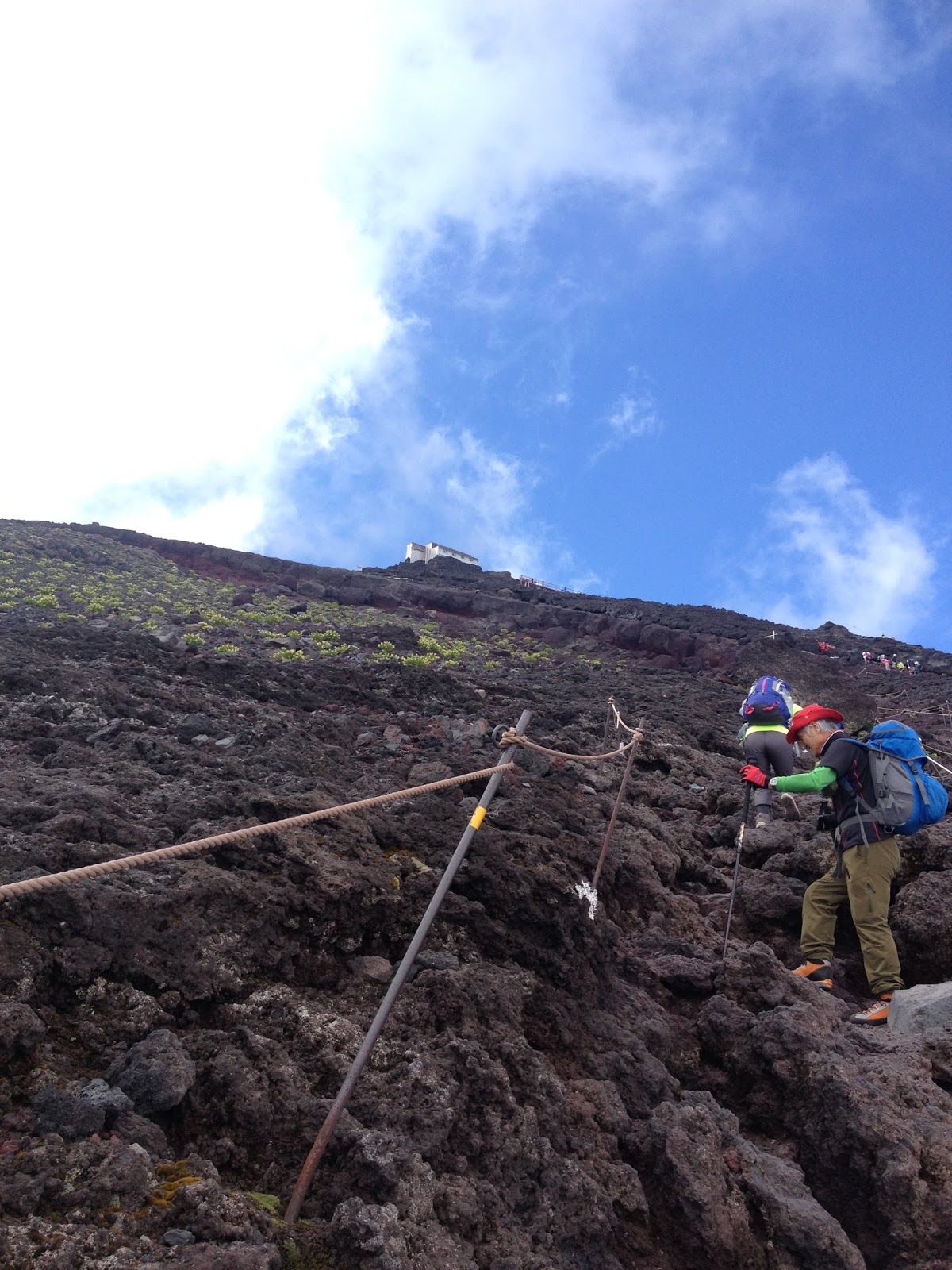 |
| Heading up to the 8th station - it gets steep |
A short time after I arrived at the 8th station I felt a headache coming on - I’m quite prone to headaches anyway so I had expected that much so I took a tablet and opened my oxygen. Then while trying to sleep about 2 hours later my headache got worse and I felt really nauseous. I had read absolutely everywhere on the internet and heard from friends in real life that the only cure is to go down the mountain, and since it was getting dark and I was alone and sick I began to panic about climbing in the dark, and the waste of money, and the shame of not reaching the summit - so in a mild hysteria I went to the cabin staff and said I was sick and needed to leave, but instead they took me to the mountain hospital, which was conveniently at that very station (this is the only hospital on the mountain so if you get sick at 9 or higher you’ll need to get back to here).
Inside they gave me a ton more oxygen and had me fill out a form (English available) with some details like how I felt and my climbing information and my name and address – then it turned out the medical student assisting the doctor lives near my apartment and is a graduate of the school I teach at! So we spoke a little conversationally in Japanese which calmed me down and distracted me, and they gave me two tablets (I think one for headache and one for nausea) and also a 500ml oral rehydration solution (tasted like salty water). I’m not sure how good their English is since we spoke mostly in Japanese, but I have a feeling it was probably better than my Japanese actually.
At the end I was asked to give a donation, I could only afford 1,000yen since I was hoarding cash for more emergencies but I would have liked to have given them 10,000 yen if there was an ATM, however they thanked me and it seemed OK, I guess most people probably don’t have a huge amount of cash to spare anyway. So anyway after maybe 30mins I felt far better but still not great, so I went back to the cabin and I slept OK and felt fine by the time I got up (about 9 hours later). I hadn’t planned to see the sunrise from the summit, so I was fine with sleeping and resting a few more hours, and actually I saw it from the side of the mountain when I woke up to go to the toilet, so I guess it worked out fine!
So the old adage of “with altitude sickness you have to get off the mountain” can now be proved untrue if you have some kind doctors to help, and also a lot of time to rest and get acclimatized! So that morning I set off for the summit, and despite having to deep breathe the whole way up and take a break literally every few steps, I actually managed to get there without feeling any more bad affects. Mountain hospital staff - I love you and thank you!
Sleeping Over
 So I’ve
touched on this in a few places already in this post. I stayed at Ikeda Kan at
the 8th station, you can book online via their website (in Japanese
but Google translate helps) and they do speak some English. It’s basically a
room full of little compartments (ranging from 3 sleeping bags to around 8 or
so maybe) and I felt it was nice and cozy. There’s WiFi but no electrical
outlets so bring a portable charger. If you’re staying at a cabin the toilet is
free but you’ll need to duck outside in some slippers (I think that’s how they
know you’re a guest and not to charge you).
So I’ve
touched on this in a few places already in this post. I stayed at Ikeda Kan at
the 8th station, you can book online via their website (in Japanese
but Google translate helps) and they do speak some English. It’s basically a
room full of little compartments (ranging from 3 sleeping bags to around 8 or
so maybe) and I felt it was nice and cozy. There’s WiFi but no electrical
outlets so bring a portable charger. If you’re staying at a cabin the toilet is
free but you’ll need to duck outside in some slippers (I think that’s how they
know you’re a guest and not to charge you). I’d read somewhere online that the cabins are really cold, but coming in from outside it seemed warmer, and I just slept in my clothes and I woke up in the middle of the night in a sweat in my hoody - maybe it was because the cabin was full and the combined body heat of 250 people brought up the temperature, I’m not sure.
The cabin staff put me in a compartment with 2 Canadian girls – so it seems they’re careful to put women/foreigners together. A few people were snoring, but since there was none directly beside me I found it actually kind of soothing. Come around midnight everyone will be stomping around and talking full volume almost constantly until daylight, while it was a little annoying I was too tired for it to bother me much – but make sure to pack your earplugs and eye mask!
I would recommend this station as a good place to stop, I feel at 7 it’s still a little far from the summit, while it would have been very tiring to make it up to station 9. In climbing time, it’s about a little over the halfway point. Also, since I got altitude sickness it was really, really convenient to be at the station with the mountain hospital! I would just recommend sleeping over in general, I know it’s an extra 5,500yen ish that you could save, but it’s a fun experience and you get to relax at least for a little while before you climb to the top.
At one point I woke up around 11pm to go outside to the toilets and I could see the moon shining brightly and the stars were all out, and below I could see many torches and flashes of lights as people climbed up. It was a really beautiful and special experience to see, and I have to admit I think climbing at night would be a special kind of experience too.
 |
| Ikeda Kan at the 8th station |
At The Summit
So,
despite there being signs everywhere on the mountain for the summit and signs
at each station (in English, Japanese, Chinese and Korean) there is literally
no sign in English at the top, at least not at the Fujinomiya station anyway!
There is a shrine and some torii gates and a Japanese flag so it’s probably pretty
obvious you’re at the top, but I was annoyed there was no definitive picture I
could take and send to my family as concrete proof, since they obviously don’t
know Japanese.
 |
| That's All Folks! |
Anyway! While I was very tired, I was more eager to actually get down as fast as possible and get home to bed, than to relax on top like some people, so I took a few photos and decided to take a quick walk around since I had climbed for 9 hours and suffered immensely to get that far!
On my quick walk I accidentally found the Mt Fuji post office, which I had totally forgotten about! Most of their sets are surprisingly cheap at around 500yen for a set anywhere between 2 and 5 postcards, and postage is included (although to a foreign country is a little extra, between 20yen-100yen depending on the size).
I opted for the certificate set, which had a B5 summit certificate (all in Japanese of course but Google translate does the job) and a regular postcard sized “Mt Fuji Summit Report” where I filled in weather, my climbing time etc, and I posted these to my family. They also have some cool ink stamps, and I was sad I had no other paper to stamp other than my postcards. Make sure to go to the post office before you head back down (but it’s only open from 6am to 2pm, making it even more special and elusive!)
 |
| The Mt Fuji Summit Post Office |
Atmosphere
By atmosphere I don’t mean
like the altitude, I mean like the attitudes of everyone. I know they say
Disneyworld is the happiest place on Earth, but Mt Fuji must be the friendliest
place on Earth! I have never felt so welcome and met as many friendly people in
a year in Japan (or maybe my whole life!) as I did in 24 hours on Mt Fuji.
Everyone is joined together, aiming to complete the same task – reach the
summit.
From when I first started climbing at the very bottom I met many people coming down saying “Konnichiwa” and “Ganbate!” which mean “Hello” and like “Good luck/You can do it!”. Some even spoke a little English to me to ask where I was from, and it seemed to me like they were happy to have an excuse to talk to a foreigner and try practice some English. For example, on the way up the mountain I had a conversation with one woman who asked was I doing OK and was surprised I was climbing alone and told me to be careful, then the next morning I saw her again (she was coming down, I was still going up!) and she asked me again how I was, and I said I had been sick and she gave me some sweets and was very kind to me.
Since I know a decent amount of Japanese I would occasionally mention to people it was hot or cold or it was difficult, and they would be surprised and very friendly and congratulate me on my average Japanese level like I was fluent! I think if you could learn a few words like “Ganbate” the Japanese will be very appreciative and impressed with you!
From when I first started climbing at the very bottom I met many people coming down saying “Konnichiwa” and “Ganbate!” which mean “Hello” and like “Good luck/You can do it!”. Some even spoke a little English to me to ask where I was from, and it seemed to me like they were happy to have an excuse to talk to a foreigner and try practice some English. For example, on the way up the mountain I had a conversation with one woman who asked was I doing OK and was surprised I was climbing alone and told me to be careful, then the next morning I saw her again (she was coming down, I was still going up!) and she asked me again how I was, and I said I had been sick and she gave me some sweets and was very kind to me.
Since I know a decent amount of Japanese I would occasionally mention to people it was hot or cold or it was difficult, and they would be surprised and very friendly and congratulate me on my average Japanese level like I was fluent! I think if you could learn a few words like “Ganbate” the Japanese will be very appreciative and impressed with you!
Souvenirs
 |
| 6th station - they all look pretty similar |
However, I didn’t buy any because about 80% of it is available throughout Shizuoka Prefecture (the area where most of Mt Fuji lies) at train stations etc or even at regular souvenir stores in Tokyo, Kyoto etc etc, so there’s nothing special about them (except the knowledge that you know you actually bought it on the mountain). If you can manage it I think the most special thing would be a postcard sent from the summit of Mt Fuji, as I already mentioned above.
Money
So
obviously there are no ATMs so you’ll need to bring a ton of cash. There is a 7-11 ATM at Shin-Fuji station which accepts international cards. I think you
should probably bring like 10,000 more than you think you need – since if you need
Oxygen it’s 2,000yen a can at the top, and I personally spent 2,000yen on four 500ml bottles of
water. I also had that trip to the mountain hospital for which I needed a
donation….
Anyway, it’s Japan and it’s incredibly safe to just leave your bag down and wander off to the toilet or take photos and come back again, no one is going to steal anything so don't be afraid to bring a lot of cash. Below is a list of some of the prices I saw while on the mountain.
Anyway, it’s Japan and it’s incredibly safe to just leave your bag down and wander off to the toilet or take photos and come back again, no one is going to steal anything so don't be afraid to bring a lot of cash. Below is a list of some of the prices I saw while on the mountain.
A list of prices as of July 2016:
Voluntary Contribution:
1000yen
I think this was at the 5th station but I easily walked by and avoided it. Obviously you should pay since it goes towards preserving the mountain and environs, but it's easy to get away with it like I did.
Large hiking stick (with bells):
1000yen
I think this was at the 5th station but I easily walked by and avoided it. Obviously you should pay since it goes towards preserving the mountain and environs, but it's easy to get away with it like I did.
Large hiking stick (with bells):
900yen
at Shin-Fuji station
1,200 at
station 6
1,000 at
station 8
 |
| Getting my stick stamped |
Stamps
for walking stick:
200yen
stations 6-9.5
300yen
station 10
So
actually I expected to pay more for the stamps for my walking stick. They were all only 200yen except at the top, but then I
got a shrine pamphlet and also a little wooden prayer thingy (I don’t
understand Buddhism so good). I was actually disappointed with the variety,
each station only had one type of stamp.
Water:
100yen
at Shin-Fuji vending machine
300 at 5th station
500 from
stations 7 up
So I was
expecting a gradual increase from like 200 to maybe 600yen closer to the top,
but even from halfway up they charge you 500yen. There are no water fountains
or any other ways to get water on the mountain, so unless you’re really strong
and can carry like 4l with you, expect to just pay the money like I did.
Toilets:
100yen
at 5th station
200yen
stations 6 -9.5
So basically
they’re all 200yen. The toilets are like a bio thing with no flusher….they're clean and have toilet paper but they all
literally smell like horse/cow shit so if you’re feeling nauseous like me it’s
not a great place to be! I didn’t need to pee that much, probably because I was
using literally every nutrient or I wasn’t drinking enough….but anyway! Most huts had someone who you paid, but some were coin operated so you need
exactly two 100yen coins (no 50yen coins for example). I didn’t go on the
summit so it may have been a little extra. If you’re staying at a
cabin the toilet is free.
Oxygen:
1,000yen
for 2 cans at a Sports Authority store
1,500 at
5th station
1,000 at
6th station
2,000 at
station 9
I’m not
100% sure of prices further up the mountain, but I definitely noticed oxygen
being slightly cheaper at station 6 than anywhere else. You may not need it,
but I got altitude sickness and even with my deep breathing techniques and a
trip to the hospital at station 8 where I got even more, I still went through 2
cans and probably could have done with one more. You’re carrying air so it’s
very light, so if possible try buy at least 2 in advance from a sports store or somewhere.
Sleeping
overnight:
5,500
bed only (well…sleeping bag)
1,000
yen each dinner/breakfast
And good luck! If I can somehow manage to pull if off, you can too. Ganbate!
 |
| Sunrise from the 8th station |


